


Astragar Platform
One platform. Three connected layers: DRM, VRM and GRC.
Everything hangs on one thing: your assets. Scan them, manage them, value the data on them, prioritize the vulnerabilities that threaten them, and prove it's all compliant, in one sequence and one data model.
Astragar sits between detection and decision, and with Aeguard it reaches into detection itself. It takes the outputs of the tools you already run, adds its own tamper-evident endpoint evidence, and turns both into decisions your board, regulators and insurers can trust. Four modules, one data model: buy one, or run them all.
Under the hood: Scan, Manage and Value (DRM) · Prioritize (VRM) · Comply and Attest (GRC) · Observe and Prove (Aeguard).

Astragar Platform
One platform. Three connected layers: DRM, VRM and GRC.
Everything hangs on one thing: your assets. Scan them, manage them, value the data on them, prioritize the vulnerabilities that threaten them, and prove it's all compliant, in one sequence and one data model.
Astragar sits between detection and decision, and with Aeguard it reaches into detection itself. It takes the outputs of the tools you already run, adds its own tamper-evident endpoint evidence, and turns both into decisions your board, regulators and insurers can trust. Four modules, one data model: buy one, or run them all.
Under the hood: Scan, Manage and Value (DRM) · Prioritize (VRM) · Comply and Attest (GRC) · Observe and Prove (Aeguard).

Astragar Platform
One platform. Three connected layers: DRM, VRM and GRC.
Everything hangs on one thing: your assets. Scan them, manage them, value the data on them, prioritize the vulnerabilities that threaten them, and prove it's all compliant, in one sequence and one data model.
Astragar sits between detection and decision, and with Aeguard it reaches into detection itself. It takes the outputs of the tools you already run, adds its own tamper-evident endpoint evidence, and turns both into decisions your board, regulators and insurers can trust. Four modules, one data model: buy one, or run them all.
Under the hood: Scan, Manage and Value (DRM) · Prioritize (VRM) · Comply and Attest (GRC) · Observe and Prove (Aeguard).
From cyber findings to business decisions.
Security tools generate findings. Astragar helps determine what they could mean to your business.
Discover
Bring together vulnerabilities, sensitive data and relevant security information.
Bring together vulnerabilities, sensitive data and relevant security information.
Quantify
Quantify
Estimate potential business and financial impact.
Estimate potential business and financial impact.
Prioritise
Prioritise
Identify what could cost the organisation most and what to address first.
Identify what could cost the organisation most and what to address first.
Evidence
Evidence
Bring security posture and control evidence into the risk conversation.
Bring security posture and control evidence into the risk conversation.
Insure
Insure
Compare modelled exposure with existing cyber insurance.
Compare modelled exposure with existing cyber insurance.
Improve
Improve
Address security and potential coverage gaps as the organisation’s risk changes.
Address security and potential coverage gaps as the organisation’s risk changes.
Platform modules
Platform modules
Four connected layers, one data model.
Module order follows the deck: DRM → VRM → GRC. Each module can stand alone, but the platform becomes strongest when all three share the same asset, control and financial-risk model. The analysis chain runs in one sequence: Scan to Manage to Value (DRM), Prioritize (VRM), Comply to Attest (GRC). Aeguard runs continuously beneath it, generating the endpoint evidence the other three reason over.
Module order follows the deck: DRM → VRM → GRC. Each module can stand alone, but the platform becomes strongest when all three share the same asset, control and financial-risk model. The analysis chain runs in one sequence: Scan to Manage to Value (DRM), Prioritize (VRM), Comply to Attest (GRC). Aeguard runs continuously beneath it, generating the endpoint evidence the other three reason over.
Module order follows the deck: DRM → VRM → GRC. Each module can stand alone, but the platform becomes strongest when all three share the same asset, control and financial-risk model.
Module 1 — DRM · Steps 1–3: Scan · Manage · Value
01
Data Risk Management
The problem
Patent-pending confidential data identification with quantitative risk analysis in networks. Discovers and classifies PII, PHI and PCI across cloud, network and endpoint.
What Astragar does
Astragar scans your assets and classifies the sensitive data on them, using a rule-based engine plus AI for context-aware accuracy and far fewer false positives. It rolls value up from element to file to asset, flags open permissions, sees inside password-protected files, and maps every finding to the HIPAA, GLBA, PCI, GDPR and NYDFS libraries.
OUTCOMES
Complete sensitive-data visibility. Materially fewer false positives. Breach exposure you can quantify.
Module 1 — DRM · Steps 1–3: Scan · Manage · Value
01
Data Risk Management
The problem
Patent-pending confidential data identification with quantitative risk analysis in networks. Discovers and classifies PII, PHI and PCI across cloud, network and endpoint.
What Astragar does
Astragar scans your assets and classifies the sensitive data on them, using a rule-based engine plus AI for context-aware accuracy and far fewer false positives. It rolls value up from element to file to asset, flags open permissions, sees inside password-protected files, and maps every finding to the HIPAA, GLBA, PCI, GDPR and NYDFS libraries.
OUTCOMES
Complete sensitive-data visibility. Materially fewer false positives. Breach exposure you can quantify.
Module 1 — DRM · Steps 1–3: Scan · Manage · Value
01
Data Risk Management
The problem
Patent-pending confidential data identification with quantitative risk analysis in networks. Discovers and classifies PII, PHI and PCI across cloud, network and endpoint.
What Astragar does
Astragar scans your assets and classifies the sensitive data on them, using a rule-based engine plus AI for context-aware accuracy and far fewer false positives. It rolls value up from element to file to asset, flags open permissions, sees inside password-protected files, and maps every finding to the HIPAA, GLBA, PCI, GDPR and NYDFS libraries.
OUTCOMES
Complete sensitive-data visibility. Materially fewer false positives. Breach exposure you can quantify.
Module 2 — VRM · Step 4: Prioritize
02
Vulnerability Risk Management
The problem
Aggregates the vulnerability scanners and security tools you already run into one de-duplicated view. Enriches every finding with exploit-status intelligence, including KEV and EPSS.
What Astragar does
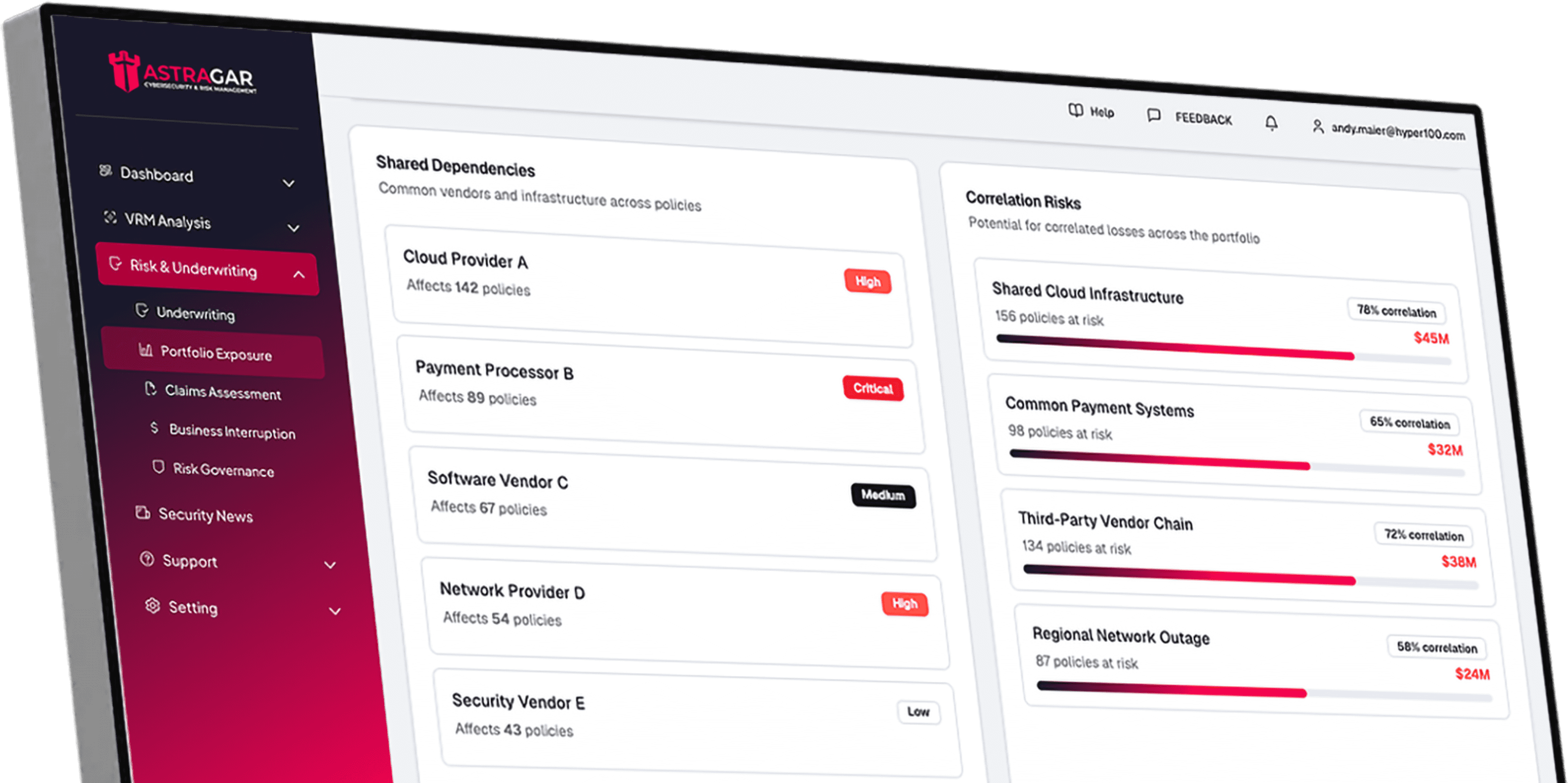
Astragar links every vulnerability to the asset it sits on and that asset's business impact, so your crown-jewel systems get fixed first. It tests exposures against NIST 800-53 and your own controls, puts a dollar figure on each vulnerability, and models what a control costs against the risk it removes.
OUTCOMES
40–60% less remediation noise. 30–50% faster MTTR on high-impact fixes. Up to 80% lower breach probability.
Module 2 — VRM · Step 4: Prioritize
02
Vulnerability Risk Management
The problem
Aggregates the vulnerability scanners and security tools you already run into one de-duplicated view. Enriches every finding with exploit-status intelligence, including KEV and EPSS.
What Astragar does
Astragar links every vulnerability to the asset it sits on and that asset's business impact, so your crown-jewel systems get fixed first. It tests exposures against NIST 800-53 and your own controls, puts a dollar figure on each vulnerability, and models what a control costs against the risk it removes.
OUTCOMES
40–60% less remediation noise. 30–50% faster MTTR on high-impact fixes. Up to 80% lower breach probability.
Module 2 — VRM · Step 4: Prioritize
02
Vulnerability Risk Management
The problem
Aggregates the vulnerability scanners and security tools you already run into one de-duplicated view. Enriches every finding with exploit-status intelligence, including KEV and EPSS.
What Astragar does
Astragar links every vulnerability to the asset it sits on and that asset's business impact, so your crown-jewel systems get fixed first. It tests exposures against NIST 800-53 and your own controls, puts a dollar figure on each vulnerability, and models what a control costs against the risk it removes.
OUTCOMES
40–60% less remediation noise. 30–50% faster MTTR on high-impact fixes. Up to 80% lower breach probability.
Module 3 — GRC · Steps 5–6: Comply · Attest
03
Governance, Risk & Compliance
The problem
Maps controls to NIST CSF / 800-53, HIPAA, NAIC, NYDFS 500, ISO 27001, SOC 2 and DORA. Supports role-based attestation with RBAC and full audit trail.
What Astragar does
Astragar maps each asset's controls to the frameworks you answer to, then lets you collect evidence once and reuse it across every regulation. Compliance status updates the moment a piece of evidence is rejected, and every control gap links straight to its dollar-quantified risk alongside VRM and DRM.
OUTCOMES
60% less audit-preparation time. Collect once, reuse everywhere. Board- and regulator-ready attestation.
Module 3 — GRC · Steps 5–6: Comply · Attest
03
Governance, Risk & Compliance
The problem
Maps controls to NIST CSF / 800-53, HIPAA, NAIC, NYDFS 500, ISO 27001, SOC 2 and DORA. Supports role-based attestation with RBAC and full audit trail.
What Astragar does
Astragar maps each asset's controls to the frameworks you answer to, then lets you collect evidence once and reuse it across every regulation. Compliance status updates the moment a piece of evidence is rejected, and every control gap links straight to its dollar-quantified risk alongside VRM and DRM.
OUTCOMES
60% less audit-preparation time. Collect once, reuse everywhere. Board- and regulator-ready attestation.
Module 3 — GRC · Steps 5–6: Comply · Attest
03
Governance, Risk & Compliance
The problem
Maps controls to NIST CSF / 800-53, HIPAA, NAIC, NYDFS 500, ISO 27001, SOC 2 and DORA. Supports role-based attestation with RBAC and full audit trail.
What Astragar does
Astragar maps each asset's controls to the frameworks you answer to, then lets you collect evidence once and reuse it across every regulation. Compliance status updates the moment a piece of evidence is rejected, and every control gap links straight to its dollar-quantified risk alongside VRM and DRM.
OUTCOMES
60% less audit-preparation time. Collect once, reuse everywhere. Board- and regulator-ready attestation.
Module 4 · Aeguard · Observe & Prove
04
Aeguard: Endpoint & AI Forensics
The problem
The first three modules make sense of the tools you already run. But no scanner, DLP or GRC register can see what an AI agent did on an endpoint once the scan has finished, and self-reported evidence doesn't survive a claims assessment or an audit.
What Astragar does
Aeguard is Astragar's own on-device sensor. It reads each AI agent's declared rulebook (permission rules, MCP tool grants, trusted-folder scopes, CLAUDE.md and AGENTS.md) and returns a verdict for every rule. It also runs a unified vulnerability scan across machine hardening and the AI-agent attack surface, learns each machine's normal behaviour, and does compliance-grade file-integrity monitoring. Every event lands in an append-only BLAKE3 hash-chain that can't be quietly edited, and feeds DRM, VRM and GRC over OSCAL and OCSF.
OUTCOMES
Attributable proof of what every AI agent did. A tamper-evident record for audit and claims. Evidence that never leaves the machine.
In beta on macOS and Windows · Apple Endpoint Security entitlement granted
Aeguard does not replace your EDR.
It is detect-only. It observes and records, it does not block. Your EDR still stops malware. Aeguard sees the layer your EDR was never built for: legitimate, signed AI agents operating outside the permissions they declared. Run both.
Fast to deploy
Fast to deploy
Live in days, not quarters.
Live in days, not quarters.
Live in days, not quarters.
Ingest what you already own: assets, CMDB, cloud and endpoints, your existing scanners, control libraries and GRC registers, and DRM works out of the box with a pre-populated sensitivity library, built-in scanning and dark-web price baselines. The result: a dollar-valued risk picture in days, not a six-month consulting project.
Ingest what you already own: assets, CMDB, cloud and endpoints, your existing scanners, control libraries and GRC registers, and DRM works out of the box with a pre-populated sensitivity library, built-in scanning and dark-web price baselines. The result: a dollar-valued risk picture in days, not a six-month consulting project.
Where Astragar fits
Where Astragar fits
What the platform covers that point tools miss.
A fast read on where scanners, EDR, CRQ and GRC tools stop, and where Astragar connects the signal into one decision layer. Two columns are new, and they are the two nobody else fills.
A fast read on where scanners, EDR, CRQ and GRC tools stop, and where Astragar connects the signal into one decision layer. Two columns are new, and they are the two nobody else fills.
Category
Vuln visibility
Data discovery
$ risk quant
Control / GRC
$-based priority
Asset valuation
AI-agent visibility
Tamper-evident evidence
Vulnerability scanners
✓
×
×
×
–
×
✕
✕
EDR / XDR
–
×
×
×
×
×
✕
–
Cyber Risk Quantification
×
×
✓
–
✓
–
✕
✕
GRC platforms
×
–
–
✓
×
×
✕
–
Astragar (DRM + VRM + GRC + Aeguard)
✓
✓
✓
✓
✓
✓
✓
✓
Astragar connects what point tools split apart.
✓ Vuln visibility · ✓ Data discovery · ✓ $ risk quant · ✓ Control / GRC · ✓ $-based priority · ✓ Asset valuation
✓ full · – partial · ✕ none. EDR / XDR is marked partial on tamper-evident evidence: the telemetry exists, but it is centrally stored and administratively mutable, so it does not carry the same weight in an audit or a claim.
How an engagement runs
How an engagement runs
How an engagement runs
Four phases. Scoped to your outcome. Agreed in writing.
Every engagement starts with a free discovery call. From there we agree scope, timeline, and investment in writing before any work begins.
Every engagement starts with a free discovery call. From there we agree scope, timeline, and investment in writing before any work begins.


Phase 01
Discovery
Scope priorities, agree success criteria, identify data sources. Free, no commitment.
Phase 01
Discovery
Scope priorities, agree success criteria, identify data sources. Free, no commitment.
Phase 01
Discovery
Scope priorities, agree success criteria, identify data sources. Free, no commitment.
Phase 02
Setup
Configure platform, integrate data sources, establish baseline measurements.
Phase 02
Setup
Configure platform, integrate data sources, establish baseline measurements.
Phase 02
Setup
Configure platform, integrate data sources, establish baseline measurements.
Phase 03
Delivery
Execute against agreed outcomes with weekly checkpoints and visible progress.
Phase 03
Delivery
Execute against agreed outcomes with weekly checkpoints and visible progress.
Phase 03
Delivery
Execute against agreed outcomes with weekly checkpoints and visible progress.
Phase 04
Handoff
Final readouts, board-ready outputs, transition plan for ongoing use.
Phase 04
Handoff
Final readouts, board-ready outputs, transition plan for ongoing use.
Phase 04
Handoff
Final readouts, board-ready outputs, transition plan for ongoing use.
Typical engagement runs 4–12 weeks depending on outcome scope. Every milestone is agreed in advance: no scope creep, no surprise invoices.
Typical engagement runs 4–12 weeks depending on outcome scope. Every milestone is agreed in advance: no scope creep, no surprise invoices.
Typical engagement runs 4–12 weeks depending on outcome scope. Every milestone is agreed in advance: no scope creep, no surprise invoices.



Start now
Start now
Tell us what you want to solve. We’ll configure the platform around it.
Whether it’s a single solution scoped tightly, or several running in parallel, the conversation starts the same way.
Whether it’s a single solution scoped tightly, or several running in parallel, the conversation starts the same way.

Start now
Tell us what you want to solve. We’ll configure the platform around it.
Whether it’s a single solution scoped tightly, or several running in parallel, the conversation starts the same way.


See your cyber risk in $ terms, not CVSS scores.


See your cyber risk in $ terms, not CVSS scores.
See your cyber risk in $ terms, not CVSS scores.